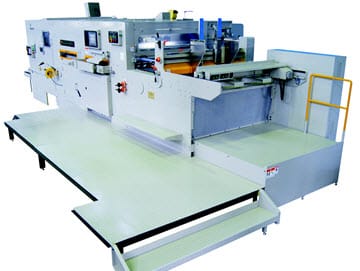
Marumatsu Vantage III
In 1981 Mikawa introduced to the world the Marumatsu M & M Autopress. Now their newest innovation is the Vantage III. Built for lean manufacturing, the machine can set-up in as little as two minutes. The lead edge feeder allows the Vantage to run many different materials including corrugated, foam core, plastic corrugated, chip and solid board.
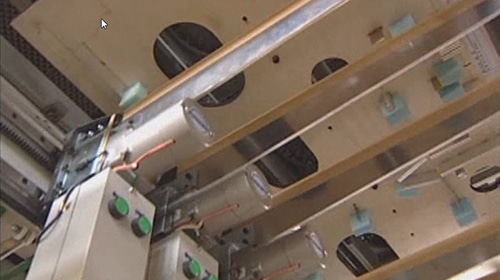
The secondary feeder is where Mikawa’s two point registration is done, achieving an accuracy of 0.011″! It’s chaseless die mounting system makes set-ups fast and make-ready a breeze. No more old style make-ready sheets, chases or set-up tables. The patented “Males Only” stripping section removes internal scrap. “No Females” necessary! Patented “Turbo-Strip” Vibration Stripper allows the machine to strip most orders with no stripping dies at all!
| Can run 0.937″ and/or 1″ rule | |
| Hundreds of installations in north America | |
| Runs Matrix with ease | |
| High speed |
Marumatsu Vantage III Specifications
| Model | PMFW-1612 | PMFW-2013 |
|---|---|---|
| Max sheet size | 47.24″ x 63.78″ | 51.18″ x 78.74″ |
| Min sheet size | 15.75″ x 23.62″ | 15.75″ x 31.5″ |
| Max die cut size | 46.26″ x 62.99″ | 50.2″ x 77.95″ |
| Max die board size | 48.62″ x 69.29″ | 52.56″ x 84.25″ |
| Min die board size | 20.87″ x 24.41″ | 20.87″ x 35.43″ |
| Gripper margin | 0.59″ +/- 0.12″ | |
| Max speed | 4,200 cycles/hour | 3,600 cycles/hour |
| Registration | 0.11″ | |
| Die cutting capabilities | From AB to G flutes / Matrix scoring | |
| Standard cutting rule size | 0.937″ (1″ upon request) | |
Frequently Asked Questions
When does short-run production make a flatbed die cutter a better choice?
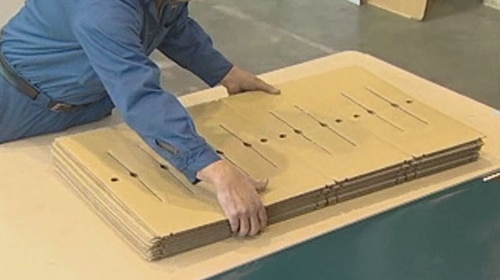
A Marumatsu die cutter can be an effective choice for short-run production when the machine’s capabilities, setup requirements, and tooling costs align with the job.
The economics depend on whether a suitable cutting die already exists, how quickly the machine can be set up, how complex the design is, and how many pieces/sheets must be produced.
For repeat jobs, specialty packaging, or short runs that require a particular cutting and creasing result, flatbed die cutting usually offers advantages over other production methods.
Manufacturers should compare the complete cost of each option, including setup labor, tooling, machine time, waste, and finishing requirements.
Hitek Equipment can help you assess your application and compare flatbed die cutting with alternative converting technologies based on your production mix.
What is the difference between digital cutting and traditional die cutting?
Digital cutting uses computer-controlled cutting tools guided by a programmed design. Traditional die cutting uses a physical cutting die manufactured to match the desired packaging shape.
Digital cutting can be useful for prototypes, samples, custom packaging, and applications involving frequent design changes because a new design may be introduced without manufacturing a new physical die.
Traditional die cutting can be advantageous for repeat production, established packaging designs, and applications where tooling and machine throughput make the process economical.
Neither method is automatically better for every job. The right choice depends on run length, board specifications, cutting complexity, required output, tooling costs, and acceptable cost per unit.
Hitek Equipment can help manufacturers compare these approaches and evaluate the equipment that best supports their production requirements.